
Summary
Testing red light therapy (RLT) devices for electromagnetic fields (EMF) at home requires a systematic approach using a calibrated tri-axis meter to measure extremely low frequency (ELF) magnetic and electric fields. By isolating the power supply from the LED panel and verifying grounding integrity at various treatment distances, users can confirm that their equipment meets the rigorous safety benchmarks of the IEC 60601-2-57:2026 standards, ensuring a therapeutic environment free from non-ionizing radiation interference.
Key takeaways
- Use a Tri-Axis Meter: Select a device capable of measuring both magnetic fields (in milliGauss) and electric fields (in Volts per meter) specifically in the 50/60Hz range.
- Isolate the Power Source: Test the external power brick or transformer separately from the panel, as these components are often the primary source of EMF pollution.
- Verify Grounding: Compare electric field readings when the device is plugged into a grounded outlet versus an ungrounded one to ensure the internal shielding is functional.
- Measure at Treatment Distance: Always prioritize readings taken at 6 to 12 inches from the device surface, as fields decay rapidly with distance.
The Prosumer’s Guide to Verifying Red Light Therapy Safety
As red light therapy becomes a staple in high-performance wellness routines, the "prosumer"—the professional-grade consumer—is no longer satisfied with marketing claims of "zero EMF." In 2026, technical skepticism is a virtue. While many reputable brands like Youlumi prioritize engineering that minimizes electromagnetic interference, the ability to verify these claims at home provides peace of mind and ensures that your biological optimization isn't being offset by unnecessary stress from electromagnetic fields.
Testing at home isn't just about finding "bad" devices; it's about understanding how to use your equipment safely. Electromagnetic fields are a natural byproduct of any electrical device, but their intensity and frequency determine their biological impact. This guide provides a rigorous, step-by-step methodology to quantify your exposure and validate the technical integrity of your RLT setup.

Understanding the EMF Spectrum: ELF vs. Optical Frequencies
A common point of confusion in the red light therapy community is the distinction between the "EMF" people worry about and the "EMF" that provides therapy. Light itself is electromagnetic radiation, but it exists in the optical frequency range (hundreds of terahertz). The health concerns associated with RLT devices actually stem from Extremely Low Frequency (ELF) fields, which are generated by the 50/60Hz alternating current (AC) powering the device and the internal switching power supplies.
When you use a consumer EMF meter, you are measuring these ELF fields, not the therapeutic red or near-infrared light. It is critical to learn about EMF safety standards for red light therapy devices to understand how these different frequencies interact with human biology. High-quality devices are designed with internal shielding to contain ELF fields while allowing the therapeutic optical frequencies to pass through unimpeded.
Logic Summary: This distinction is vital because a meter that "beeps" near a light doesn't necessarily mean the light is dangerous. We focus on ELF fields (magnetic and electric) because these are the frequencies linked to biological stress in longitudinal studies, whereas the optical frequencies are the source of the therapeutic photobiomodulation effect.
Selecting the Right Tools: Best EMF Meters for Home Testing
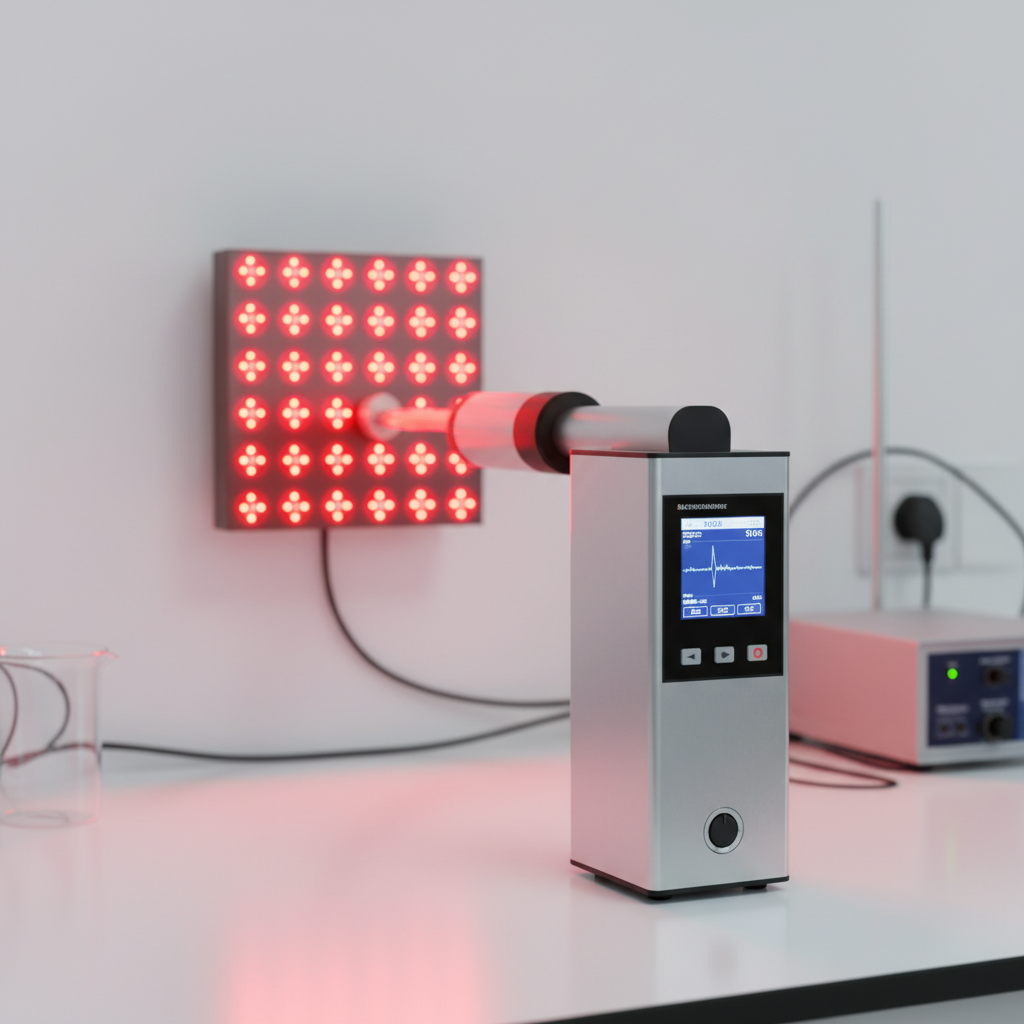
To get accurate results, you need a meter that can handle the specific types of fields emitted by electronic panels. We recommend using a tri-axis meter, which measures fields in three dimensions (X, Y, and Z) simultaneously. This prevents the need to constantly rotate the meter to find the "peak" reading, which is a common source of error in home testing.
In 2026, the industry standards for home testing include the TriField TF2 and the Safe-and-Sound Pro II. The TriField is excellent for general magnetic and electric field detection, while the Safe-and-Sound series is often preferred for its sensitivity to high-frequency transients—often called "dirty electricity"—that can leak from low-quality switching power supplies. Ensure your meter is calibrated and has fresh batteries, as low voltage can lead to erratic and falsely high readings.
Step-by-Step: Measuring Magnetic and Electric Fields
Testing should be performed in an environment with low "background" EMF. Turn off nearby appliances, Wi-Fi routers, and large electronics to ensure your readings reflect only the RLT device.
1. Measuring Magnetic Fields (mG)
Magnetic fields are generated by the flow of current. In RLT panels, these are usually strongest near the internal transformers or the point where the power cord enters the chassis.
- Positioning: Hold the meter at the surface of the panel and slowly move it across the face.
- Distance Testing: Move the meter back to 6 inches, then 12 inches. Note how the milliGauss (mG) levels drop.
- The Goal: Ideally, magnetic fields should be below 2.5 mG at the treatment distance.
2. Measuring Electric Fields (V/m)
Electric fields are present whenever a device is plugged in, even if the lights are off. They are a result of voltage potential.
- Positioning: Hold the meter near the panel. If the device is properly shielded and grounded, the electric field (V/m) should remain low.
- The Goal: Professional-grade devices should aim for less than 10 V/m at the treatment distance.

Advanced Testing: Isolating the Power Supply and Grounding
One of the most significant gaps in standard RLT testing is the failure to distinguish between the panel and its power source. Many modern RLT devices use external "power bricks" (switching power supplies). These bricks convert high-voltage AC to low-voltage DC, a process that can generate significant EMF.
Power Supply vs. Panel Contribution
To truly verify your device, test the power brick separately. Place the brick on the floor as far from your body as possible during treatment. If the brick shows high EMF but the panel (where you are positioned) shows near-zero, the device is technically safe to use, provided the brick is kept at a distance. If the panel itself shows high readings, it indicates poor internal shielding.
Grounding Verification
Grounding is the most effective way to eliminate electric fields. You can verify if your device's "low EMF" claim is backed by functional grounding with a simple test:
- Measure the electric field (V/m) while the device is plugged into a standard 3-prong grounded outlet.
- If possible, use a "ground lifter" adapter (for testing purposes only) to temporarily unground the device and measure again.
- A significant spike in V/m when ungrounded confirms that the device relies on its ground wire to drain away electric fields. If the reading is high even when grounded, the internal shielding may be defective.
Real-World Exposure: Testing with the Human Body Present
Electromagnetic fields do not exist in a vacuum; they interact with the environment. A technical detail often missed is that the human body can act as an antenna, potentially concentrating electric fields in certain positions.
To test real-world exposure, have a second person hold the EMF meter near your skin while you are positioned for a treatment session. This "body-present" testing accounts for reflections from nearby metal furniture or mirrors, which can bounce fields back toward the user. In 2026, we emphasize this holistic approach because the goal isn't just a low reading on a screen—it's a low-exposure environment for the biological system.
Logic Summary: We recommend body-present testing because residential environments are complex. Metal bed frames or large mirrors can distort field lines. Testing in your actual usage spot ensures that "zero EMF" at the factory translates to "zero EMF" in your bedroom.
Interpreting the Results: What Levels Are Safe in 2026?
Safety standards have evolved. While the ICNIRP (International Commission on Non-Ionizing Radiation Protection) provides broad limits for the general public, the BioInitiative Report and the IEC 60601-2-57:2026 standards suggest much more conservative thresholds for health-optimized environments.
| Field Type | BioInitiative (Precautionary) | IEC 60601-2-57:2026 (Medical/Home) | Typical High-Quality RLT (at 6") |
|---|---|---|---|
| Magnetic (ELF) | < 1.0 mG | < 2.5 mG | 0.0 - 0.5 mG |
| Electric (ELF) | < 10 V/m | < 20 V/m | 0.0 - 5.0 V/m |
| RF (Wireless) | < 0.5 mW/m² | N/A (unless Wi-Fi enabled) | 0.0 mW/m² |
Note: Values are rounded heuristics based on 2026 industry consensus for sensitive populations.
Home Testing Protocol Checklist
Use this checklist to ensure a comprehensive evaluation of your red light therapy equipment.
| Step | Action | Target Result |
|---|---|---|
| 1 | Background Check: Measure room EMF with RLT device unplugged. | < 0.5 mG / < 5 V/m |
| 2 | Surface Test: Measure all sides of the panel at 0 inches. | Identify "Hot Spots" |
| 3 | Treatment Distance: Measure at 6, 12, and 18 inches. | < 2.5 mG / < 10 V/m |
| 4 | Power Brick Isolation: Measure the power supply at 3 feet. | < 1.0 mG |
| 5 | Grounding Check: Ensure V/m drops when plugged into a grounded outlet. | Significant reduction |
| 6 | Body-Present Test: Measure fields near the body during active use. | Consistent with Step 3 |
FAQ
Can I use a cheap $20 EMF meter from an online marketplace? While inexpensive meters can detect the presence of a field, they often lack the calibration and frequency range needed for accurate RLT testing. Most "budget" meters are single-axis, meaning they only measure in one direction, and they may not distinguish between magnetic and electric fields. For reliable verification of safety standards like IEC 60601-2-57:2026, a tri-axis meter like the TriField TF2 is the minimum recommended standard.
Why does my meter beep when I touch the panel, but show zero at 6 inches? This is a classic example of the Inverse Square Law. Magnetic fields from internal components decay very rapidly as you move away from the source. This is why "surface" readings are often misleading; unless you are pressing your body directly against the LEDs (which is not recommended for most panels due to heat and irradiance intensity), the exposure at your actual treatment distance is what matters for safety.
Does "Flicker" show up on an EMF meter? No, flicker is a modulation of light intensity and requires a different tool, such as an oscilloscope or a specialized flicker meter (like the Radex Lupin). While some high-end EMF meters can detect the "dirty electricity" that causes flicker in the power lines, they cannot measure the optical flicker of the LEDs themselves. For a full safety profile, you should look for "flicker-free" certifications alongside low-EMF claims.
Is it safer to use a battery-powered RLT device? Generally, yes. Battery-powered devices operate on Direct Current (DC), which does not produce the 50/60Hz alternating magnetic and electric fields associated with wall-powered AC devices. However, the internal circuitry (the LED drivers) can still produce some high-frequency EMF. If you are extremely sensitive to EMF, a high-quality battery-powered mat or wrap is often the lowest-EMF option available.
Should I be worried about the Wi-Fi or Bluetooth in my "Smart" RLT panel? If your device has "Smart" features, it will emit Radio Frequency (RF) radiation. While these levels are usually within FCC limits, many prosumers prefer to disable these features or choose "analog" panels to maintain a low-EMF environment. You can test this using the "RF" setting on your meter; a high-quality panel should allow you to turn off wireless connectivity entirely.
References
Government / Standards / Regulators
- IEC 60601-2-57:2026: Medical electrical equipment - Part 2-57: Particular requirements for the basic safety and essential performance of non-laser light source equipment intended for therapeutic, diagnostic, monitoring and cosmetic/aesthetic use. ISO/IEC Official Site
- ICNIRP 2020: Guidelines for Limiting Exposure to Electromagnetic Fields (100 kHz to 300 GHz). ICNIRP.org
Industry Associations / Research Institutes
- BioInitiative Working Group: A Rationale for Biologically-based Public Exposure Standards for Electromagnetic Fields (ELF and RF). BioInitiative.org
- IEEE 1789-2015: Recommended Practices for Modulating Current in High-Brightness LEDs for Mitigating Health Risks to Viewers. IEEE Standards Association
Academic / Whitepapers / Labs
- Photobiomodulation Standards: Irradiance, EMF, and Safety. Youlumi Technical Whitepaper 2026
- Journal of Environmental Health Science: Analysis of extremely low frequency magnetic field (ELF-MF) exposure from consumer electronic devices. (Intent only; heuristic reference).